
From its industrial heritage to its growing strengths in areas such as advanced manufacturing, health tech, space, photonics, quantum, and artificial intelligence, Glasgow has long been a city shaped by engineering and innovation.
Today, that legacy is evolving.
Across the city, universities, startups, investors, industry, and innovation organisations are working together to create an environment where new technologies can move beyond the lab, reach the market, and grow into ambitious businesses.
Last month, that community came together for Glasgow Tech Week, bringing founders, investors, academics, creatives, and industry leaders together to share ideas, build connections, and explore the technologies of the future.
For us, the week was also an opportunity to celebrate the engineering entrepreneurs already building that future across Scotland.
Building an ecosystem for engineering innovation
Glasgow combines world-class research with a strong industrial base and an increasingly connected entrepreneurial community. The city is home to major universities and research institutions, established engineering businesses, emerging technology companies, investors, accelerators, and organisations supporting entrepreneurs at different stages of their journey.
Collaboration between these communities is particularly important for deep tech businesses. Turning research-intensive engineering into a successful company can take time, specialist expertise, patient investment, and access to the right networks.
What makes Glasgow special is how willing people are to come together, share ideas, and support each other.
- Alisdair Gunn, Director of Glasgow City Innovation District
Creating stronger connections between researchers, founders, investors, industry, and policymakers can help promising technologies make that journey from breakthrough idea to real-world impact.
Synaptec is one example of what that journey can look like - growing from research at the University of Strathclyde into a Glasgow-based engineering company operating on a global scale.
Member spotlight: Dr Phillip Orr, Dr Neil Gordon - Synaptec
Founded in Glasgow in 2014 as a university spinout, Synaptec develops photonic sensing systems that are transforming how electricity networks monitor critical infrastructure. Its Distributed Electrical Sensing technology uses existing optical fibre networks to measure voltage and current across wide areas, supporting power grids, renewable energy projects, and industrial infrastructure.
Today, Synaptec’s technology is deployed around the world, including on major offshore wind projects and national electricity networks across the UK, Europe, India, and the Gulf. The company has grown to a team of 30, raised more than £10 million since incorporation, and is on track to double its revenue in 2026 compared with 2025.
Synaptec also has a long-standing connection with the Enterprise Hub. CEO and Founder Dr Phillip Orr became Scotland's first awardee on our flagship start up programme, Enterprise Fellowship in 2014. Following the launch of the Enterprise Hub in Scotland in 2024, Phillip encouraged colleague Dr Neil Gordon to join the Shott Scale Up Accelerator. Neil completed the programme in 2025 and has since become CTO at Synaptec, demonstrating how the Hub can support engineering entrepreneurs and their teams at different stages of a company’s growth.
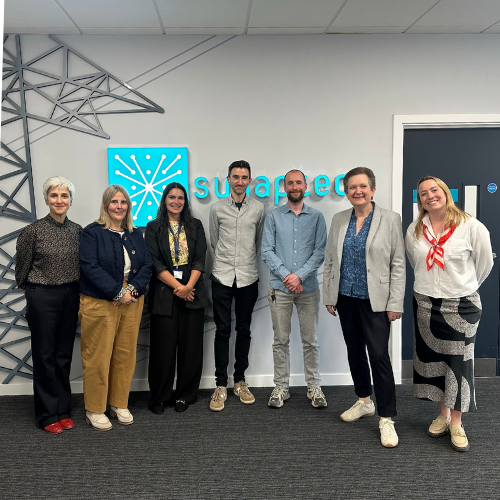
Dr Phillip Orr and Dr Neil Gordon alongside our Royal Academy of Engineering team
From research to real-world impact
One of Glasgow's strengths is its ability to bring research, engineering expertise, and entrepreneurship together.
But a breakthrough technology is only the beginning. Building a company around it requires founders to develop new skills, find customers and partners, attract investment, build teams, and navigate the transition from research and development to commercial scale.
Across Glasgow and Scotland, engineering entrepreneurs are making that transition.
Member spotlight: Maria Cerezo Sanchez, Co-Founder & CEO of Neurobite Technologies
This Glasgow-based company is developing a dissolvable medical device for the temporary monitoring and treatment of neurological conditions, including post-stroke recovery and drug-resistant epilepsy. Designed to dissolve when no longer needed, it could eliminate the need for surgical removal, reducing costs and clinical risks.
Through our Enterprise Fellowships programme and wider Enterprise Hub community, Maria has been supported in making the transition from researcher to entrepreneur and developing Neurobite’s commercial potential.

Maria Cerezo Sanchez
I come from academia and was just finishing my PhD when I started the company. I started it not really knowing how to be a CEO or how to run a business in general. The Enterprise Fellowship programme has helped me lay the foundations that I want to have in my company... not only understanding how to set up a company but also how to set up a good work culture”
- Maria Cerezo Sanchez, Co-Founder & CEO of Neurobite Technologies
Supporting Scotland's engineering entrepreneurs
The Royal Academy of Engineering established its Enterprise Hub in Scotland in Glasgow to bring its support closer to engineering and technology entrepreneurs across the country.
Based within the Glasgow City Innovation District, the Hub’s Senior Enterprise Manager, Emma Loedel works with founders, universities, businesses, investors, and partners across the Scottish innovation ecosystem.
Through the Enterprise Hub, entrepreneurs can access funding, mentoring from experienced engineers and business leaders, specialist training and coaching, investor connections, and the wider national and global network of the Royal Academy of Engineering.
The aim is not simply to help create more startups, but to support ambitious engineering entrepreneurs as they develop technologies, build companies, and tackle major economic, environmental, and societal challenges.
Creating the conditions to scale
The stories behind these companies demonstrate the breadth of engineering innovation emerging from Scotland, but also the importance of the ecosystem around them.
Exceptional technology needs access to expertise, investment, customers, talent, and networks if it is going to achieve its full potential.
That makes opportunities to bring different parts of the ecosystem together particularly valuable.
Glasgow Tech Week provided a chance to make those connections, share experiences, and explore what more can be done to help engineering and technology companies start, grow, and scale from the city.
What’s next?
Glasgow has the ingredients to play an important role in the next generation of engineering and technology businesses.
Realising that opportunity will depend on continuing to connect the different parts of the ecosystem - from universities and entrepreneurs to investors, industry, government, and organisations supporting innovation.
Glasgow Tech Week offered a snapshot of what that connected ecosystem can look like: a city coming together around ideas, technology, entrepreneurship, and opportunity.
For the Enterprise Hub, our role is to keep those connections going long after the week comes to an end.
We want to help more of Scotland's engineering entrepreneurs turn breakthrough technologies into successful businesses, connect them with the people and expertise they need, and ensure ambitious innovators can build and scale from Scotland.
Find out more about the Royal Academy of Engineering Enterprise Hub Scotland and the support available to engineering and technology entrepreneurs.
Browse more
The Entrepreneur's Handbook
A practical guide for aspiring academic entrepreneurs to understand and navigate the spinout process.
Enterprise Fellowships
Turn your engineering innovation into a successful company Applications are now closed. Sign up to hear when the applic…