
In just six years, two founders who never considered themselves conventional academics turned a University of Oxford spinout into a $1.075 billion acquisition - building one of the UK’s most significant deep tech success stories along the way.
Oxford Ionics was founded by Dr Tom Harty and Dr Chris Ballance with a bold idea: to rethink how quantum computers are built.
In 2025, the company was acquired by IonQ for $1.075 billion, becoming the first Enterprise Hub Member company to achieve unicorn status.
For our community, this was a landmark moment. Not simply because of the scale of the acquisition, but because it demonstrates what is possible when world-class engineering, entrepreneurial ambition and a strong innovation ecosystem come together.
We recently spoke with Shott Scale Up Accelerator alumnus and Hub Member Dr Tom Harty about the journey behind Oxford Ionics, hearing how he scaled breakthrough research into a globally significant engineering business.
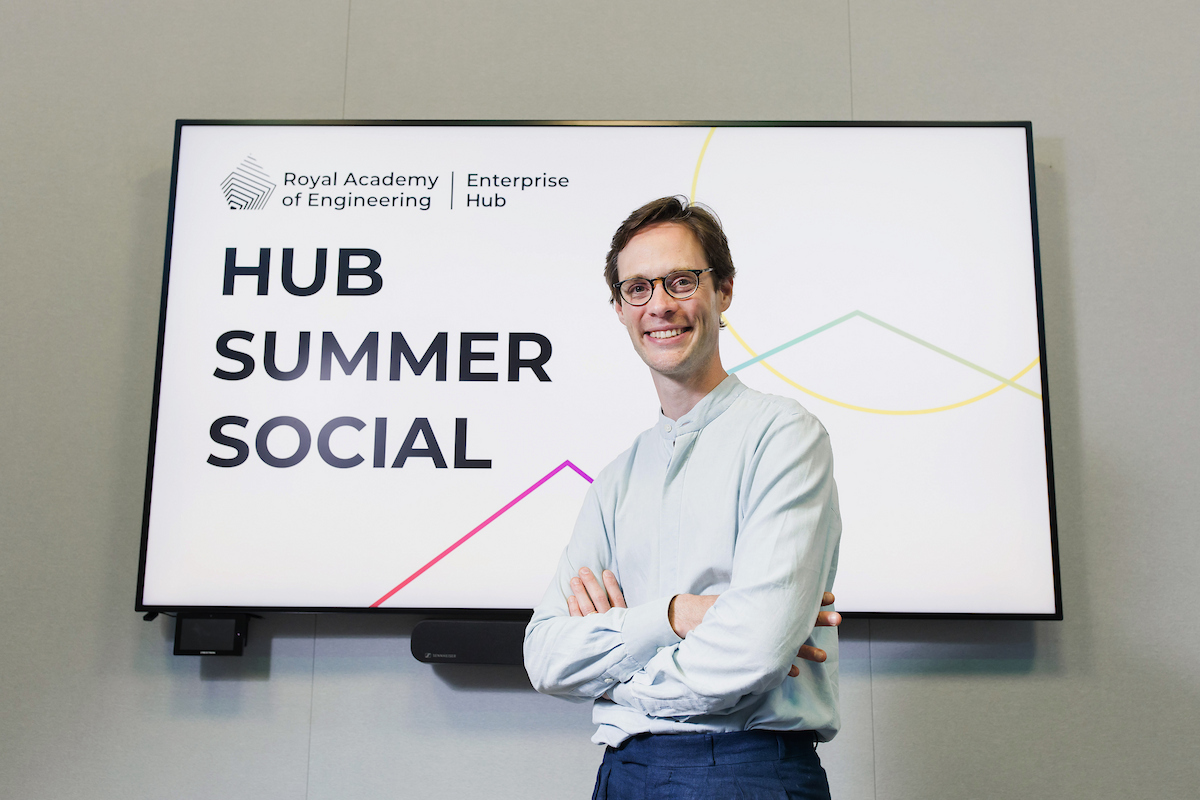
If you want to build one of these companies, you must have a big vision. You have to ask yourself: if we succeed, how will the world look different?
Start with the problem, not the technology
Tom's route into quantum computing wasn't entirely linear. He started out studying Physics and Philosophy, drawn to some of the deepest questions in the field. While immersed in theory, he had a lightbulb moment.
"I realised I was a practical person," he said. "I wanted to go and build something."
Around 2010, quantum computing was reaching a pivotal moment. Scientists had shown the underlying technology could work, but nobody had demonstrated what a practical, scalable and manufacturable quantum computer would look like.
Most systems relied on intricate laser arrays to control their qubits - an approach well suited to the research lab, but much harder to scale.
Oxford Ionics took a different approach. Its patented Electronic Qubit Control technology uses precision electronics, not lasers, to control trapped-ion qubits. By separating the quantum layer from the classical semiconductor chip beneath, the company could combine world-leading quantum performance with established semiconductor manufacturing techniques and supply chains.
Rather than treating scalability as a problem to solve later, it was engineered into the architecture from the beginning.
The results speak for themselves. Oxford Ionics has set world records across the three defining performance metrics for trapped-ion quantum computing. Its technology is already trusted by leading organisations, including the UK's National Quantum Computing Centre and Germany's Cyberagentur, and the company is on a clear path towards quantum computers with millions of qubits by 2030.
It was an engineering solution to what much of the field still treated primarily as a scientific problem. That shift in perspective became the company's defining advantage.
Ambition is an engineering skill
Tom describes himself and Chris during their academic years as less than conventional academics - not because they lacked scientific rigour, but because neither was motivated by incremental research.
A conversation with Royal Academy of Engineering Fellow Hermann Hauser KBE FREng FRS, prominent entrepreneur and VC, helped crystallise that ambition. After hearing about their technology, Hauser challenged them: either it was not as transformative as they believed, or, if it was, they had no business staying in academia.
It was the push they needed to build a company. For Tom, ambition is not an abstract quality - it shapes the scale of the problem a founder chooses to solve and the decisions along the way:
"If you want to build one of these companies, you must have a big vision," Tom said. "You have to ask yourself: if we succeed, how will the world look different?"
Building a globally significant engineering company demands more than solving hard technical problems - it demands the confidence to pursue outcomes that are difficult, uncertain and genuinely transformative.
Go and talk to people who are two, three or four steps ahead of you, they can't necessarily give you the answer because every situation is different. But they can tell you what the problem is called, the different ways it can play out, and the consequences. Having that crystal ball is a real cheat code.
No founder builds a company alone
Tom credits many of Oxford Ionics' biggest decisions not to flashes of individual inspiration, but to conversations with founders who had already travelled the road ahead. He described those conversations as "a cheat code."
That perspective helped the team understand the choices in front of them, anticipate future challenges and make better decisions more quickly.
Engineering programmes offer breathing space
It is also why he values programmes that bring ambitious engineering entrepreneurs together.
As an alumnus of the Enterprise Hub's Shott Scale Up Accelerator, Tom found enormous value in stepping away from the daily demands of running the business to think strategically alongside other entrepreneurs.
For entrepreneurs tackling difficult engineering challenges, access to the right people who understand the road ahead can be just as valuable as access to capital. Bringing together engineering entrepreneurs, Academy Fellows, mentors and industry experts has long been central to the Enterprise Hub’s approach: supporting engineering entrepreneurs access the right expertise and relationships at the moments that matter most.

Great companies grow in great ecosystems
Oxford Ionics' success is often told through the lens of its founders and technology. But Tom is quick to point out that exceptional founders need exceptional ecosystems.
The UK's quantum sector did not emerge overnight. It is the product of decades of investment in research, talent and specialist engineering capability.
Tom points to Oxfordshire as an example. Its concentration of Formula One teams has created extraordinary precision engineering expertise - skills with direct relevance to building advanced quantum hardware. Combine that with one of the world's strongest pools of quantum researchers and institutions including the National Quantum Computing Centre, and you have a fertile environment for a company like Oxford Ionics to grow.
Yet Tom believes the UK still has work to do.
The UK is exceptional at generating breakthrough ideas, yet historically, less successful at scaling them into globally significant businesses. Too often, he believes, ambition becomes constrained by caution.
"We have a very good engineering culture, but sometimes people let that get in the way of ambition."
World-leading engineering companies are rarely built in isolation. They emerge from ecosystems that connect research, talent, capital, infrastructure and long-term support from organisations like the Enterprise Hub.
Build value, not an exit
The acquisition by US company IonQ attracted headlines worldwide. But Tom is clear that building a company to sell was never the primary goal.
When IonQ discussions began, Oxford Ionics had a £130 million Series B on the table – this was not a company running out of options. The decision was about more than capital, it was about whether they could achieve their mission faster together than apart.
The networking was incredible - the Royal Academy of Engineering has such a strong network and global community that I met people who were genuinely helpful.
IonQ brought global manufacturing capability, commercial infrastructure and complementary expertise that could significantly accelerate the company's original vision. Tom and Chris spent many late nights wrestling with the decision – including, in Tom’s words, whether they were "selling the baby."
Looking back, he has no regrets: "I would do this deal ten times out of ten."
Oxford remains a major R&D hub for IonQ demonstrating how world-leading UK engineering can continue to create value at home, while contributing to the future of quantum computing globally.
Building the next generation of engineering unicorns
Oxford Ionics is an extraordinary success story. Perhaps its greatest significance is what it represents.
Its journey from university spinout to $1.075 billion acquisition, in just six years, was built through years of scientific excellence, engineering rigour, commercial thinking, relentless execution and a willingness to think bigger than felt comfortable.
As the first Enterprise Hub Member company to achieve unicorn status, Oxford Ionics demonstrates what is possible when breakthrough engineering is matched with entrepreneurial ambition.
Every year, we work with engineering entrepreneurs who are building technologies capable of solving the world’s most complex challenges - from clean energy, advanced manufacturing to healthcare, AI and quantum technologies.
Many are at the beginning of journeys every bit as ambitious as Oxford Ionics’ once was.
By connecting our entrepreneurs with investment, expertise, mentoring and one of the UK's most influential engineering networks, we aim to help more engineering entrepreneurs turn breakthrough ideas into globally impactful companies.
And the relationship continues. Tom remains an active part of the Enterprise Hub community, sharing the experience he has gained with entrepreneurs now navigating challenges he once faced himself.
His simple advice to the next generation of engineering entrepreneurs: "Think really, really big."
Browse more articles
Scaling Ambition: Shott Scale Up Accelerator alumni share lessons in leadership
The Shott Scale Up Accelerator is designed to elevate senior leaders and founders in high-growth UK engineering and tec…
Spotlight series: From research to global impact: the rise of Hypervision Surgical
Hypervision Surgical is at the forefront of transforming surgical imaging and improving outcomes for cancer patients wo…
More than a milestone: what being named the UK’s top startup hub really means
The Enterprise Hub being named the UK’s top startup hub by the Financial Times and Statista is an incredible honour. Bu…