The problem
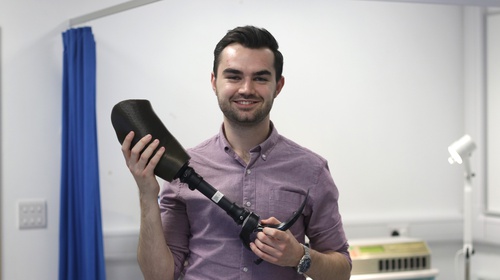
External medical devices that attach and apply pressure to the skin, such as prosthetics, orthotics and respiratory masks, often do not fit properly, leading to pain and injury for the user. An average of nine clinical visits is usually required before a comfortable fit is achieved for a prosthetic limb after amputation. The lack of analytical tools can result in the fitting of these bespoke devices becoming a lengthy and frustrating process.
The solution
Radii Devices aims to improve the fit of external medical devices and increase the quality of life for patients. Dr Joshua Steer formed the company as a spin-out from the University of Southampton’s Bioengineering Sciences Research Group in 2019. It exploits the biomechanical modelling and analysis he has developed to give clinicians more accurate predictions of fit during the prosthetic socket design process.
Imaging techniques, such as laser and MRI scanning are used to capture the shape of the individual’s limb. This enables Radii Devices to track shape change over time, generate computational models to predict pressure at the limb-prosthetic interface, and compare results across the population to forecast the comfort of a particular socket. Healthcare professionals can then view this analysis to support their choice of optimal socket.
The World Health Organization estimates that 30 million people worldwide are in need of prosthetic and orthotic devices. This number is due to rise, driven by an ageing population and increasing incidence of diabetes, which is the leading cause of amputation.
As an engineer, Joshua wants to solve real-world problems. His technology could be applied to any external medical device that applies pressure to the skin such as ankle-foot orthoses, wheelchair seating, and footwear. The company is running clinical pilots of its software in 2020 aiming to achieve full product launch soon after. Radii Devices is simultaneously working on collaborative projects for other medical devices such as respiratory face masks for intensive care, to help manufacturers improve the quality of fit.
Joshua says: “The Fellowship has given Radii Devices the best possible launchpad to translate our research into clinical and commercial use. It has provided us with the skills, expertise and support to refine our business model, raise our first funding round and commence clinical pilot studies.”
Traction
2015 Institute for Mechanical Engineering (iMechE) Vicon Award
2019 Dr Joshua Steer was awarded an Enterprise Fellowship
2019 Radii Devices spun out of the Bioengineering Sciences Research Group at University of Southampton
2019 Secures £100,000 of investment at Future Worlds Dragons’ Den event
2020 Launched at the Consumer Electronics Show
2020 Commences pilot studies of the software with clinicians
Visit their website: www.radiidevices.com