
Two weeks ago, I took a group of Enterprise Hub Members to Silicon Valley, to meet investors, potential customers and British engineers and business leaders working in the region. What struck me was not the money available, although access to capital matters. It was how quickly the right connections could happen.
One founder had spent more than a month trying to reach someone they needed to speak to. During our visit, that connection was made in minutes. Nobody had planned a formal introduction. It was simply what a well-connected network made possible.
Many of the people opening those doors were British engineers who had trained here and still cared about the UK's success. Yet they were better connected to one another across Silicon Valley than many of our own companies are across the Pennines.
It left me with a question: if we can open those doors for a British founder in California, why is it still so difficult for a founder in Sheffield, for example, to find the right person in Newcastle?
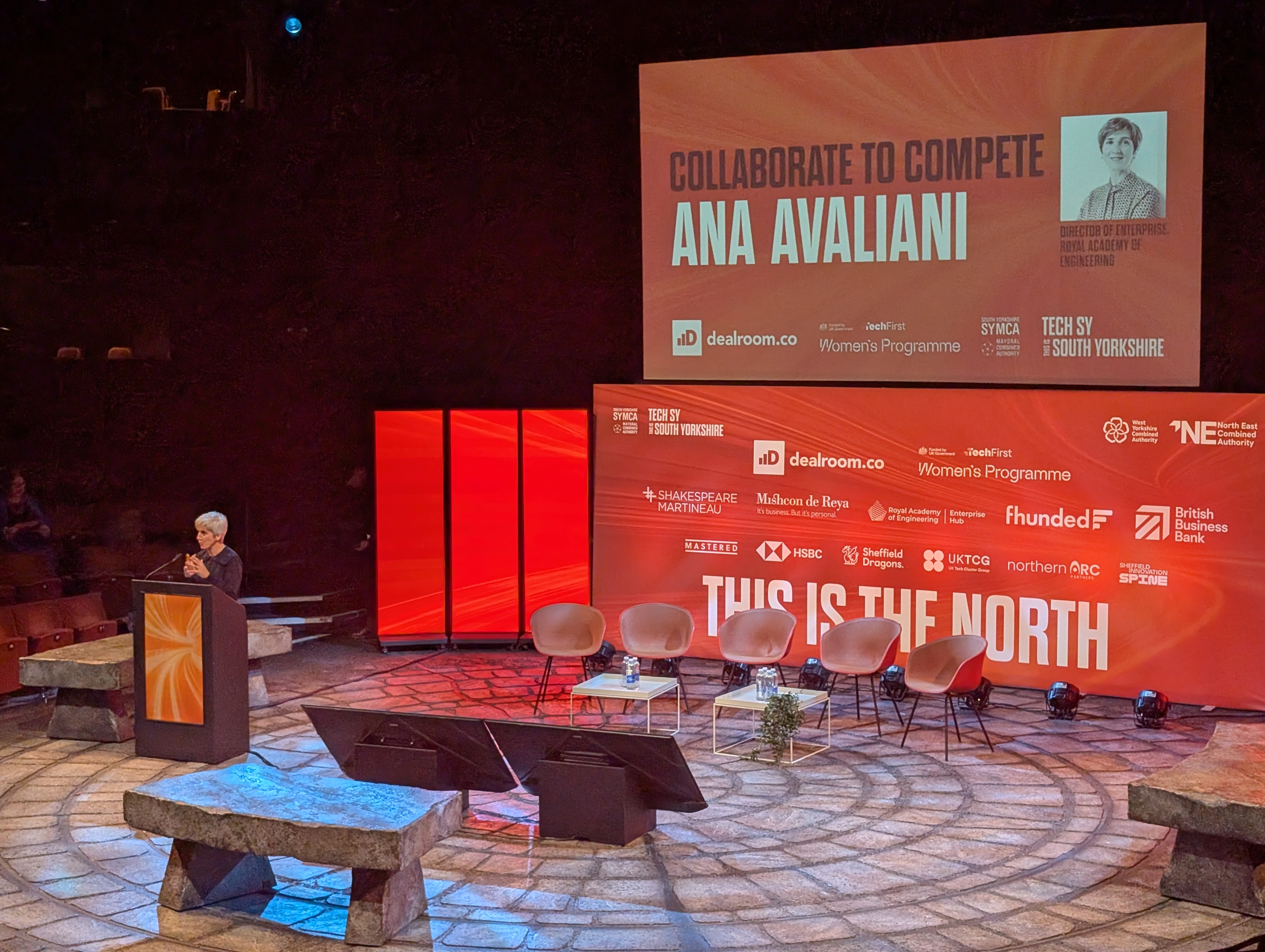
Connecting the North’s engineering strengths
The North already has many of the ingredients needed to compete as a global centre for engineering innovation: world-class research, entrepreneurial talent, established industries, and deep technical expertise. The opportunity is to connect them more effectively.
The Academy's work on Engineering, Economy and Place puts the engineering economy at up to £747 billion in direct gross value added each year, supporting 8.5 million jobs. The average engineering job generates almost a quarter more value than the average UK job.
But invention alone is not enough. Promising technologies must be tested, validated, manufactured, adopted, and scaled. Without that journey from discovery to deployment, brilliant ideas can remain in the laboratory while their economic value is realised elsewhere.
The North is well placed to bridge that gap because its strengths are complementary. South Yorkshire has advanced manufacturing and materials expertise; West Yorkshire has strengths in health innovation, data, and digital; Greater Manchester combines AI with industrial capability; the North East brings energy and offshore engineering; and the Humber is a centre for clean energy, logistics, and manufacturing. Each is valuable in its own right. Connected, they become a powerful national asset.
Making the system work for founders
Fragmentation has a real cost. A founder may need manufacturing expertise, specialist facilities, a first customer, or an investor, yet have no clear route to find them. Investors may see isolated opportunities rather than the wider pipeline of engineering businesses emerging across the North. Valuable knowledge remains within institutional boundaries, leaving founders to navigate a complex landscape alone.
The lesson from Silicon Valley is not that the North should try to replicate it. Our strengths are different. The lesson is that networks can make expertise, capital, customers, and commercial relationships easier to access and that connection should happen by design, not chance.
This is where the Royal Academy of Engineering can play a distinctive role. Our regional presence gives us roots in local communities and ecosystems, while our national reach enables connections across geography. Our Hubs in Liverpool, Sheffield, and Newcastle are part of a wider Academy network spanning Belfast, Glasgow, Swansea, and London.
Through our Enterprise Hub, we have supported more than 600 entrepreneurs, who have created around 6,100 jobs and raised approximately £3.8 billion in follow-on funding. They remain part of the community for life, with continuing access to mentors, peers, investors, customers, and technical expertise.
Turning collaboration into action
To make the North operate as a connected innovation system, we need three things.
- Shared networks, so founders can access expertise, partners and customers across the North as a matter of course, not by chance.
- Shared intelligence, giving us a clearer picture of where capabilities exist, where gaps remain and what businesses need. The Academy's work on technology adoption can help identify opportunities to support engineering firms to adopt technologies that improve productivity and competitiveness.
- Shared practice, so regions can learn from successful approaches elsewhere rather than continually reinventing solutions.
This requires action from the whole ecosystem. Policymakers need to recognise the realities of engineering innovation, including long development cycles, patient capital and specialist facilities. Investors need to look beyond familiar locations. Universities must make it easier for ideas, people and facilities to move into commercial use. Large businesses can make a vital contribution by becoming early customers for emerging technologies. Organisations like ours must share knowledge, reduce duplication, and judge success by outcomes rather than activity.
Competing as a system
The competition is not Manchester against Sheffield, Leeds against Newcastle, or the North against London. The real competition is global. Industrial regions around the world compete as connected systems, bringing together research, industry, capital, and talent to get technologies built, certified, financed, and sold at scale.
The North has the assets to do the same. Its opportunity is to connect them. When a founder in Sheffield reaches a materials expert in Manchester or a manufacturer in the North-East, that is not a win for one city at another’s expense. It is a win for the whole region and potentially a contract that might otherwise have gone elsewhere in the world.
The North does not simply need to participate in the UK’s growth story. By connecting its engineering strengths and helping more innovations reach commercial scale, it can help write that story and show the world the results in the things we build.
Browse more
Enterprise Hub named Tech Hub of the Year
We've been named Tech Hub of the Year at the Prolific North Tech Awards 2026.
Building Europe’s deep tech backbone
How do we turn Europe’s exceptional deep tech talent into a lasting advantage? Ana Avaliani explores the shift we need…
The UK’s deep tech spinout moment and what we still have to fix
The answer isn't just about world-class research. It's creating an ecosystem where great ideas can move from the lab to…